
How Sounder Analytics Works
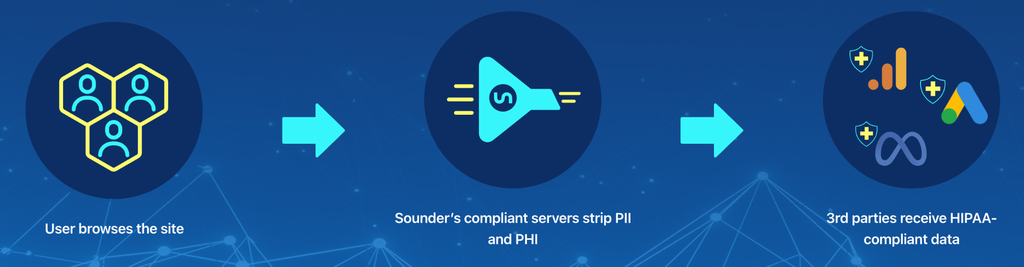
Today, your website sends tracking data directly to Google. With Sounder, that data goes to Sounder’s server first. There, anything that could identify a person is stripped out: IP address, device fingerprinting data, user identifiers, and similar details. Only the cleaned data moves on to GA4. Your reports are built from that cleaned data, so the reports still work. They just can’t be traced back to an individual.
What stays the same
This is the same GA4 interface, the same login, and the same standard reports. Your team does not need retraining. Specifically, you keep:
- Page-level data: pageviews, engagement time, and the Pages and Screens report
- Landing page reports
- Events, key events (conversions), and key event conversion rates
- Source, medium, and campaign attribution for every session (see the note on attribution below)
- Custom explorations, including session funnels, path explorations, and free-form reports
- Web vs. mobile traffic reporting
- State-level location reporting
- Custom dimensions and metrics you have set up on events and pages
- Any Data Studio dashboards or scheduled reports built on the data above
What changes
Every item below is stripped from the data stream on our server. Any data that identifies a person or a specific device is removed. Removing that data is what makes the analytics safe to run on a healthcare site.
| GA4 feature | Today | With Sounder | Why |
|---|---|---|---|
| User counts and new vs. returning users | GA4 recognizes a visitor across sessions | Every session is treated as a new user, so “Users” will roughly equal “Sessions” | No user identifiers are sent to GA4 |
| User Lifetime reports | Available | Not available | Requires tracking a person across visits |
| Multi-session User Explorations and cohort explorations | Available | Not available | Same reason |
| First-user (first-touch) attribution | Available | Not available. Attribution is last-click, session-based only | First touch requires remembering the person’s earlier visit |
| Demographics: age, gender, interests, language | Available when Google Signals is on | Not available | Built from Google’s profile of the individual |
| Location detail | Country, state, city | Country and state only | City-level location combined with other data can identify a person |
| Tech Details: browser, operating system, screen resolution, device model | Available | Not available. Web vs. mobile still works | Device details are fingerprinting data |
| Google Signals audiences and remarketing lists | Available | Not available | Requires identifiable users |
Attribution notes
Source, medium, and campaign reporting still works, and you can still see which channels drive key events. The difference is that credit goes to the channel that brought the visitor in for that session (last click). If someone finds you through a Google search on Monday and comes back through a paid ad on Thursday to book an appointment, GA4 with Sounder credits the Thursday ad. It cannot connect the two visits, because connecting them would mean tracking the person.
Summary
If your team’s day-to-day questions are “How many people visited?”, “Which pages did they read?”, “Where did they come from?”, and “Did they convert?”, nothing about how you answer those questions changes. What you give up is the ability to follow an individual over time, and on a healthcare website that is exactly the ability you do not want to have.